
Posted by Rob Snowdale on Wed, Jan 23, 2013 @ 01:59 PM
The Situation:
So you ship to small to medium sized companies and you come to agreement with your customer that you will sell your product on afreight prepaid and add basis. After all, you ship a lot of goods and probably have better freight rates than your customer. You select the carrier, you dispatch the carrier and you pay the carrier. Then you invoice the customer for your product and for the freight charges.
The Options:
A surprising number of companies decide to mark up the cost of the freight charges and make an additional profit in this way. On the other hand, some companies pass on the freight charges with no markup.
The Rationale:
Those that decide to mark up the freight cost have thought it through. They feel that it’s their overall shipping volumes (volumes that their customer does not have) and their hard work in making sure they have ('the most competitive freight rates') possible that allow them to mark up the freight. They feel their internal costs of picking the product, packaging, calling the carrier, loading the freight and the carrying costs of paying the freight invoice prior to the customer reimbursing the freight cost should be compensated in some way.
Those that decide to simply pass on the freight cost without markup feel that their competitive freight rates allow them to compete with vendors who may be closer to the customer and if they mark up the freight costs this might not allow them to make the sale in the first place. We’ve also had clients who think the practice of marking up freight costs is just not good business practice.
The Reality- It’s all in the Freight Payment Terms
The fact is if you sell your goods with freight payment terms that specify Prepaid, Add and Handling you are perfectly within your rights to mark up the freight costs without recourse on the part of your customer. The internal costs of preparing and shipping your product referenced above is the legitimate rationale for marking up the freight costs and the inclusion of the word 'Handling' addresses those very real and significant costs.
Where you can get in trouble is marking up the freight costs with freight payment terms of sale that are simply Freight Prepaid and Add. If you markup your freight costs on a Prepaid an Add term, your customer can in fact ask you for a copy of the actual freight invoice as verification that the itemized charge for freight is accurate and has not been marked up. Additionally if the freight invoice copy does not match the itemized freight charge on your invoice for goods sold, your customer can ask for and is legally entitled to a refund on the difference of the marked up freight charge and the actual freight charge.
The possible loss of good will and confidence from the customer if you’re caught with your hand in the cookie jar ( not specifying the correct freight payment terms ) , so to speak, is certainly not a good thing and in fact could cause you to lose the customer and possibly involve you in a lawsuit.
The same scenario works on inbound shipments to your firm. Do you buy from vendors on a Freight Prepaid and Add basis? If you do there is a very good possibility that your vendor is marking up the freight costs on their invoice for materials to you. Ask for a copy of the freight invoice to determine if they are marking up the freight costs. Maybe you’re entitled to a refund.
For more information about freight payment terms of sale, its implications and your possible recourse, contact Distribution Solutions, Inc.- DSi today!
Posted by Robert Snowdale on Tue, Jan 15, 2013 @ 12:11 PM
Is Your Company Effectively Managing Your Shipping and Receiving Costs?
Click here 5 Key Questions to find out.
Your answers to these 5 Key Questions will provide you with a clearer understanding of how effective your internal efforts at managing shipping and receiving costs are.
Shipping and receiving costs, while not the #1 line item expense on your company’s P&L’s, should be managed as efficiently as your top line item expenses. For many companies shipping and receiving expenses are NOT managed as efficiently as top line item expenses. Purchasing decisions in this area are often made on personalities and personal preferences and not on sound business principles and practices. An undisciplined practice in this area results in unnecessary costs and companies losing a competitive edge to their competitors; especially those competitors located closer to their customers.
Transportation Spend Management (TSM) is a discipline taught for many years in business schools. Its current day application in most companies however is a bit of a “lost art”. The answers to these 5 Key Questions may be simple enough to answer but the solutions that can change your answers are difficult for most companies to implement on their own. Without the metrics and technologies necessary for a disciplined TSM practice most companies will continue to spend more than necessary , lose business to their competitors and receive less than optimum results for their efforts.
We are Distribution Solutions, Inc. – DSi, and this is our 23rd year of working with manufacturers, distributors and wholesalers in reducing freight costs and bringing visibility to the logistics function and its associated costs. We have offered our solutions and answers to these 5 Key Questions as successfully practiced today for our clients.
How do your company’s efforts and results in managing transportation costs compare to other companies in your industry? Do you know? We do!
Call us today for a no cost, no obligation assessment of your shipping and receiving costs at 508-747-6200.
Posted by Robert Snowdale on Tue, Jan 08, 2013 @ 11:54 AM
Between fuel prices and an uncertain market environment, companies who do not make concessions to their clients on shipping costs will lose market share to their competitors who have a more attractive landed cost of goods sold. To improve market share you have to rely on more than just your carrier’s good will to ensure you are getting the best pricing.
Carriers are more concerned with increasing their profits than they are about making concessions, even if they can obtain higher volume accounts. Shipping rates are rising, and to cut costs you have to find a solution that will bring negotiating leverage to the table and help you benchmark your current costs so that future savings can be measured accurately.
Many companies who have been successful at keeping shipping costs low and improving their market position have outsourced their freight procurement requirements to Transportation Spend Management (TSM) consulting companies who control millions of dollars in freight spend. This can have a huge impact on shipping and freight charges, and will enable you to focus on other important business processes and priorities.
Why Should You Outsource to a TSM company?
- TSM companies can help to lower shipping rates, achieve greater concessions, and gain better services overall
- TSM Companies can increase your shipping departments productivity through the implementation of technology tools not currently available
- You gain the ability to analyze cost of inventory, freight costs, and improve your Cost of Goods Sold
- Outsourcing can help you retain existing customers and increase sales and improve business processes at a faster rate.
As a line item expense freight and logistics cost should be managed as efficiently as your top line item expenses. Unfortunately for most companies these costs are not managed professionally and purchase decisions are often made on a relationship basis with little regard to cost and service. The positive effects of partnering with a TSM company can be compounding and result in major business transformations.
There is a key that fits into the proverbial lock of cutting costs and improving customer retention in the supply chain world and it starts by knowing where to collaborate and with whom.
DSi’s proprietary Transportation Spend Management programs can provide data on industry specific benchmark costs so you can evaluate how you compare to your competitors. A DSi freight management program typically saves 20% or more using name brand carriers who can meet or exceed your service requirements.
Contact us today to learn more about our ”Guaranteed Freight Cost Savings” programs. If we don’t meet or exceed our savings projections to you, we write you a check for the difference.
Posted by Robert Snowdale on Wed, Dec 12, 2012 @ 11:23 AM
Probably More Than You Think!
Carriers take GRI’s (General Rate Increases) every year and in some years more than once per year. If you make shipments of over 150 lbs and use the major LTL carriers your rates increased just last summer.
Here is a list of some of the top LTL carriers and their summer 2012 rate increases:
ABF (Arkansas Best Freight) - 5.9% increase Effective: 06/20/2012
Conway - 6.9% increase Effective: 06/21/2012
Estes Express - 6.9% Increase Effective: 08/08/2012
Fedex Freight - 6.9% Increase Effective: 07/09/2012
Old Dominion - 4.9% Increase Effective: 08/06/2012
UPS Freight - 5.9% Increase Effective: 07/16/2012
YRC Freight - 6.9% Increase Effective: 06/25/2012
What You Probably Don't Know About These GRIs
THE PERCENTAGE INCREASES LISTED ABOVE ARE ONLY “AVERAGES” - IN FACT, DEPENDING ON WHERE YOU SHIP TO OR FROM YOUR LTL RATES WENT UP EVEN HIGHER!
The increases listed above are the average increases across all origin and destination zip code combinations that each individual LTL carriers services. These guys are smart! They have analysts and yield engineers who look at all of their shipping history and determine what parts of the country are imbalanced ( i.e. much more outbound than inbound or inbound than outbound) or otherwise problematic for them. They then increase their rates in those areas significantly higher than the “ published” or announced GRI average.
So if carrier A has a balance issue in the Southwest and you happen to be shipping a good percentage of your shipments to or from this area, you didn’t just take a 6.9% increase you might have been hit with a 10% or 15% increase.
Worse, since you’re not on their yield team and don’t know how and where they engineered their base rates, you’ll never know how much of an increase you are dealing with.
Why Distribution Solutions, Inc?
We are DSi, and this is our 22nd year of working with manufacturers and distributors to help reduce their freight costs, and improve their marketplace competitiveness. Our services bring visibility and efficiency to the supply chain through management services and technology.
To compare your current LTL costs to the kind of LTL costs a DSi program can achieve for you, click on the link below:
Compare Your LTL Rates >>
For more information about DSi and how our services may help you, please click on the link below to view a brief 3 minute introduction to DSi:
Watch Video >>
Posted by Robert Snowdale on Wed, Dec 05, 2012 @ 11:07 AM
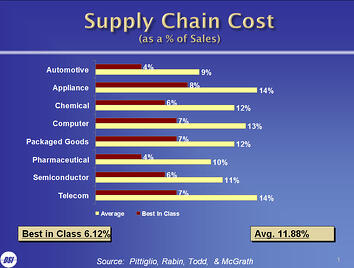
Hey, Freight Costs are not my worry-I am told by our shipping manager that we have GREAT freight rates. Of course every shipping manager thinks they have great freight rates but how competitive are they? How do they compare with other similarly sized companies in similar industry sectors?
To find out how your company compares to others in your industry sector in terms of Supply Chain Costs as a percentage of sales click here.
The old and very true adage goes "if you’re not measuring it, you’re not managing it." Assuming your company has some measurements in place, how do you know if your measurements merit a slap on the back or a well-placed kick?
Large, well run public companies expect every line item expense to be managed from a Best in Class approach. Entrepreneurs and their employees in smaller, privately held businesses may think they stack up well against their peers--even as they lose market share month after month to competitors who can offer similar products at a better landed cost.
We are DSi, and this is our 24th year of working with small to medium sized companies to improve the responsiveness of their logistics performance and to provide guaranteed freight savings using name brand carriers that meet or exceed client specific service requirements.
Best in Class Operating Practices
Here are six operating practices that can help you achieve a Best in Class level of Freight Cost Management within your company:
- Establish "Business Rules"- what does it take to be a freight carrier in good standing for your company?
- Conduct annual bid processes using a Uniform Disclosure Document with all qualified carriers leveraging all available volumes, inbound, outbound, third party.
- Select and award business on a one year contract to a right-sized Core Carrier Group (the Goldie Locks approach- not too many, not too few).
- Establish current Benchmark costs for all modes of transportation.
- Implement and distribute Routing Guides for all shipments, and measure and report compliance with those guides.
- Measure performance against Benchmark costs, Routing Guides and Business Rules through Freight Audit, Payment and Management Reporting services.
How Do I Get Started?
Most small to medium sized companies do not have the resources to bring a Best in Class management approach to this key line item expense, nor are they able to measure and report performance in this area.
Call us today at 508-747-6200 to find out more about how we can help you to achieve Best in Class performance in this area.
“Best in Class”- Definition: "The highest current performance level in an industry used as a standard or benchmark to be equaled or exceeded.”
Posted by Robert Snowdale on Fri, Jan 29, 2010 @ 01:07 PM
In today's uncertain economic times, most companies are seeking ways to cut costs. Smart companies are looking long and hard at their business processes to identify new opportunities for savings. The smartest companies know the biggest savings are often achieved with the smallest operational changes --and many are scrutinizing their distribution and supply chain management models.
This is the story of one Massachusetts company - a leading manufacturer of woven jacquard fabrics for the high-end home furnishing industry - whose shrewd assessment of how they got their product from one place to another generated a seven-figure cost reduction.
In addition to manufacturing fabrics for the high-end home furnishing industry, this company held additional contract fabric lines selling to automotive interior, office furniture, wall coverings, and freestanding panel manufacturers. Highly sought for its automotive interior fabric line, the Massachusetts company was bought by a larger Michigan based fabrics producer whose business plan dictated that they concentrate solely on automotive fabrics.
These kinds of mergers usually produce redundant operating systems, and this one was no exception. The Michigan-based company maintained a private fleet that served much of the company's distribution and supply chain needs and also procured and managed the company's purchased transportation requirements. The Massachusetts company asked DSi to assess their current logistics and supply chain requirements and costs.
DSi's assessment uncovered an inefficient and costly transportation system in which intra-plant shuttle activity was set up on a time schedule, rather than being tied to peak production periods. Basically, the trucks weren't going out with full loads and the company was losing money.
This money-losing process was developed for two well-meaning reasons: 1) to insure that looms and weaving facilities were supplied with dyed yarns and 2) to insure that finishing plans had woven fabrics within hours-regardless of available quantities. As a short run producer, the resulting constant set-up and takedown of beams for loom operations and return of fabric racks required same-day deliveries on 53-foot trailers that were loaded with small quantities of product.
"Just-in-Time" to the Rescue
Working with the company, DSi carefully plotted production schedules and material requirements for those production schedules. DSi's goal: To design, develop, and coordinate a just-in-time shuttle schedule that would reduce transportation cost inefficiencies.
Just-in-time is an inventory strategy that strives to improve a business's return on investment by reducing in-process inventory and associated carrying costs. The philosophy of JIT is simple: Inventory is waste. JIT focuses on having "the right material, at the right time, at the right place, in the exact amount" - without the safety net of inventory.
The subsequent schedule eliminated duplicate runs for materials and dunnage not required by each specific plant's production schedules. In further discussions with the transportation firm, DSi negotiated truckload and half truckload (LTL transportation) pricing for deliveries that required the company to ship smaller quantities and allowed the shuttle company to more closely match their equipment capacities with the fabric company's load requirements.
With the combination of DSi's leveraged and professionally conducted formal RFP processes, aggressive freight audit error recovery, just-in-time scheduling and optimization of truckload and LTL transportation, our client achieved first-year savings of $1,408.540.
Read the complete LTL Trucking CASE STUDY>>
Posted by Robert Snowdale on Tue, Nov 17, 2009 @ 07:28 PM
If you are fortunate enough to be shipping your frozen or temperature maintained product in full truckload quantities you have a fairly wide range of refrigerated (reefer) carriers to negotiate with and award contracts to. On the other hand if you are shipping in less than truckload (LTL) quantities the options and available carriers represent a considerably smaller range of choice. Most refrigerated LTL shipping revolves around one or two freezer locations and local radius shipping in support of the freezer location. You can count on one hand the number of national or long haul carriers providing frozen or temperature maintained LTL services.
Even those "national" players may not match your desired origins and destinations due to limitations in their service area. In addition even the larger scope LTL carriers publish a sometimes restrictive pickup and delivery schedule that might not meet your required delivery or pickup dates. There are hundreds of local, niche LTL reefer carriers serving limited service areas but few if any in that market that come close to the breadth and scope of service and territory that their dry freight LTL trucking brethren can offer.
In addition to the local niche asset based carriers there are even more brokers or non asset based logistics companies that make a market in matching their customers LTL freight with other customers LTL freight to build truckloads with stop offs. They too however are also plagued by limited service areas and restrictive operating schedules. In short the infrastructure is not there to easily move smaller lot shipments anywhere at anytime for reasonable prices. Most of the refrigerated trucking carriers or brokers charge on a per pallet or weight basis for their services.
These factors and others help to explain why a frozen or temp maintained LTL shipment generally moves for multiples of what a similar size and weight of dry freight would cost to deliver. Fuel costs also drive pricing levels in this market as refrigerated tractor trailer units not only burn diesel to power their tractors but also burn diesel to maintain temperatures as low as 0 degrees. The refrigerated units installed on reefer trailers run continuously until the load is offloaded. The driver may turn off his tractor and grab some sleep but the refrigeration unit on the trailer continues to burn diesel to protect the integrity of its load. Not much market demand for wilted flowers or runny ice cream!
At the other end of this situation is the refrigerated truckload market. The truckload market has plenty (in comparison) of local, regional and national players looking for loads. The competition in this market results in some very competitive pricing. So competitive in fact compared to the LTL arena, that it often doesn't take more than several pallets of heavy product to result in a lower cost to place those several pallets on a truckload unit and run it as a truckload. So there go eight pallets weighing 16,000 lbs taking up 16 ft. on a 53 ft. trailer for a cost equal to or less than what the reefer LTL carrier or broker would charge. Most truckload reefer carriers charge for their services on a per mile basis. While loads can max out at 44,000 lbs, the reefer truckload carrier doesn't generally care what the shipment weighs( although the weight is a factor in fuel consumption); they run from point to point for an agreed upon rate per mile without much regard to the weight of the shipment.
If your average consignment is one or two light weight pallets every other week, you're really up against it. Not too many options and steep prices and lengthy transit times to move your product to market. On the other hand if you have multiple shipments daily with pallet weights of more than 1,000 lbs per pallet, and if you also have a mix of one or two pallet consignments and larger lot consignments than you might be able to reduce your time to delivery and reduce your costs greatly by building your own loads.
You could work with brokers who mix and match shipments to build truckloads but in these cases your looking at a 15% to 20% markup at a minimum over direct carriage costs. So if you have the right mix of frozen or temp maintained shipments you could build your own loads.
In addition to the right profile of shipment frequency and density the last piece in the puzzle to be successful in this process is the technology piece. Given the complexities and variations of due dates, shipment size, weight, loading and unloading schedules, appointments, mileage between stops and driver hours of operations regulations you would be hard pressed to build loads that met all of your customers requirements and the realities of space, weight and distance with out such technology.
There are a number of load optimization software programs whose sophisticated algorithms can provide intelligent load planning that builds cost effective, straight line stop off loads that meet required delivery dates at total cost considerably lower than the direct LTL refrigerated shipping options discussed earlier herein.
Available LTL pricing and truckload pricing, stop off charges and other pricing criteria are uploaded to the optimization software to compare direct LTL pricing with truckload with stop off pricing. The setup of the software also configures other variables such as driving time, loading or unloading time, and appointment dates and time to insure realistic load planning. Uploads of shipping level detail from your order entry system are run multiple times per day to update all shipping orders allowing the optimization software to run multiple combinations of the orders to build optimal loads that meet required delivery times and produce savings of 20% or more.
There are a number of Transportation Spend Management (TSM) consulting companies who make a market in temperature controlled and frozen LTL consolidation using these technologies. These TSM companies can run a 30 day sampling of your LTL invoices through the load optimizer to determine the feasibility of load planning for your specific situation. If this is an option for you the TSM companies generally work on a percentage of savings or on a fixed fee.
It's not right for everyone, but with the right mix of shipments it's a great way to improve transit times to your customers, significantly reduce your freight shipping costs and to increase your refrigerated trucking shipping options. That's what they pay us for right?
For a case study illustrating the benefits of frozen refrigerated LTL consolidation services, click here.
Posted by Rob Snowdale on Mon, Sep 14, 2009 @ 01:46 PM
A bill of lading is a legal contract between carrier and shipper for transporting goods. It also specifies the terms and conditions of carriage, and influences the rates and charges associated with that carriage and serves as a receipt for goods received by the carrier from the shipper.
I am amazed at what I see being used by many small to medium sized shippers to tender a shipment to their carriers. Documents used range from a packing slip to a print out from their order entry system, neither of which serve the purpose of a bill of lading. Of those shippers that use a standard uniform bill of lading form available almost anywhere; many have no idea how to fill out the form.
The handwritten scrawl used to describe the commodities being shipped routinely use "pet" names for their product such as " 20 cases of brightener". While "brightener" as a product description might convey exactly what it is to anyone within the company, I can guarantee you it would cause most rating clerks for the carriers involved to scratch their heads, provided they could read the writing in the first place.
You might ask.... "So what's the big deal? We may not have a perfectly executed Bill of Lading every time we ship something but we haven't had any problems." You haven't had any problems that you are aware of yet, would be my response.
Your product descriptions are an important part of insuring a correct application of rates and charges on your outbound shipments. Those descriptions need to carry a National Motor Freight Classification (NMFC) item # and attendant freight class. When carrier rate clerks have to interpret what you are shipping they generally interpret your freight to be a higher rated class carrying a higher rate.
Here's a specific example of what improper commodity descriptions could be costing you:
One of our client's inbound vendors located in Butner, NC shipped three freight collect shipments of the exact same commodity by the same carrier.
The product is listed and described on all three bills of ladings filled out by the vendor as: " polymers/iokyurethanes combined with textiles".
Because there is no NFMC description that matches that description rate clerks for the same carrier interprets the description and rates each shipment in the following manner:
One as: Item#49880-Sub 3 - Class 100- Clothing, density of less than 12 Lbs per cubic ft.- 2,195 Lbs rated @ $32.52 per hundred lbs.
Another as: Item #29275-Sub 1- Class 92.5- Corrugated boxes, less than 12 Lbs per cubic ft.-1,013 Lbs rated @ $36.83 per hundred lbs.
Another as: Item #43490-Sub 2- Class 85- Chemicals, not otherwise indicated in bags, boxes, drums or packages -1,426 Lbs rated @ $34.00 per hundred Lbs.
Does anyone know how to fill out a bill of lading with proper National Motor Freight Classification Item #'s and Freight Class anymore? Short answer- not many, and especially not this vendor.
The product in question happens to be cloth or fabric coated with vinyl in rolls with cloth backing. Item # 49210- Class 65. The collective overcharge resulting from improper product descriptions on these three shipments alone is: $385.81 not a large sum, but as a percentage, 24.6% greater than correctly applied contract charges.
What is a 24.6% overcharge on your current annual outbound freight bill worth to you? Is your vendor properly describing your inbound freight collect shipments? If you don't have a Freight Audit, Payment and management company looking out for your interests, money could be flying out the door.
Additional more obvious problems from bill of lading issues could range from denied freight claims for loss or damage to recourse against you for freight charges that weren't supposed to be your responsibility in the first place. Volumes have been written on the legal problems involving improperly conveyed goods on an improperly executed bill of lading, suffice it to say It's in your best interest to do it right the first time.
For many companies the solution to these issues may be Bill of Lading software packages. There are a number of on line bill of lading software packages that automate the execution of a bill of lading with pre-programmed freight descriptions carrying accurate NMFC item #'s and freight classifications. You may need to consult a Transportation Spend Management company to insure that the set up of your product descriptions are accurate.
These on line bill of ladings systems are generally not expensive and can save you time and money in a number of ways. In addition to accurate product descriptions that will eliminate overcharges, some additional benefits to name a few are:
- 1. Stored carrier, and customer records for retrieval and reuse
- 2. Pre programmed routing instructions to know which carrier to use for different customers
- 3. integration with your order entry system to auto generate the Bill of Lading
- 4. Pre shipment carrier rating functions
- 5. Shipment summary detail used for reporting
- 6. Shipment tender and pickup notification to the carrier
For most companies the time, effort and expense associated with purchasing a bill of lading software system and setting it up properly will be paid back quickly in efficiencies received and costs avoided.
Learn about DSi's freight shipping services.
Posted by Rob Snowdale on Fri, Jul 10, 2009 @ 11:33 AM
So most likely you fall into one category or another on this issue. Either you recognize that freight bill post payment audit services is a viable option for you, or you don't.
If you do, you realize that the average recovery on freight billing errors ranges from 3% to 8% and you have a strategy in place to recover those freight bill overcharges.
If you don't utilize these services you either aren't aware of the practice of post payment audit recovery, or you don't think it's worth the effort to look into it.
I can tell you personally that freight carriers make a lot of mistakes and most of those mistakes are not in your favor. Many freight vendors today are actually outsourcing their invoicing functions, which ultimately increases the overcharge/error ratio. The number of freight overcharges and the cumulative dollar amounts of those overcharges we see sometimes makes me wonder if the outsourced vendors the carriers work with are compensated on some percentage of the dollar amount invoiced.
Post audit recovery involves certain statutes of limitation concerning the time frame in which you can recover an overcharge. In the absence of any negotiated agreement to extend those times the time limitations which vary by transportation mode and or vendor are as follows:
- Motor Freight (LTL or TL): 180 days from date of delivery
- Air Freight: 6 Months from date of delivery
- Ocean Freight (FCL or LCL): 30 to 180 days depending on forwarder/carrier involved
Most post audit firms work on a contingency basis at 50% of overcharge claims filed and paid. If they don't recover the overcharge, you don't pay for their services.
The essential ingredient for a successful freight bill post audit program is a robust audit trail of contracts, rate publications and other rate documentation from the participating carrier group. If you negotiate your freight rates on the back of a cocktail napkin it's unlikely that post audit will be a successful ploy for you and your company.
Some companies don't use post payment audit services because they feel the have a good outsourced or in-house pre-payment audit system. I tend to favor pre-payment audit systems that detect the error before you pay the invoice for the following reasons:
- Pre-payment audit services are pennies on the dollar, you can either detect a $500 overcharge and pay $.85 for the pre-payment audit or you can pay $250.00 to detect the same overcharge on the post audit.
- Some freight companies can really drag their feet on overcharge claims- why fight for the overcharge if you detect and eliminate it before its paid?
Most CFO's are all over freight bill post audit services and routinely put their paid freight invoices out for post audit. At the same time most CFO's completely overlook a much larger opportunity. Let's call it a "competitive freight audit." It's great to get 25% back on an overcharge occurring on a small percentage of invoices that are billed in error. How much greater would it be to understand that every invoice was 20% higher than it needed to be even if it was correctly invoiced? Just because an invoice is correctly charged for doesn't mean that your not overpaying for freight services.
There are a number of companies who can evaluate your freight spend in concert with your business rules and required service parameters. They can even provide freight cost benchmarking by specific industry so you can evaluate where you are vs. where you could be. A competitive freight audit involves:
- Providing a Complete & Current 30-90 Day Sampling of Invoices
- Providing an understanding of service requirements, business rules and SOP's
With this information a competent TSM (transportation spend management) consultant can create a database model of your current freight invoices. The next step is to apply achievable pricing parameters to that model for annual savings projections deliverable from the design and implementation of a Core Carrier program that meets or exceeds all indentified business rules. The design, and delivery of such a program is also within the scope of a competent TSM consultant.
Every freight invoice should be audited against contract rates, pre or post payment as a standard procedure. Having taken those steps the last and most often overlooked step should be to evaluate and benchmark your freight costs. You'd be amazed at what you may learn!
Posted by Rob Snowdale on Wed, Jun 17, 2009 @ 05:14 PM
The concept and practices of Transportation Spend Management (TSM) have been taught in business schools for years. In reality it is a little used and understood discipline in most small to medium sized companies. With transportation spend approaching fifty (50%) percent of total logistics costs and logistics costs trending higher, many CFO's or other "C","V" level personnel are asking questions about transportation spend management within their organizations. More often then not the answers they receive to those questions indicate a missed opportunity to create competitive advantage and to improve profitability.
So, you might ask, "what's the upside of implementing a properly structured and executed TSM program and how do we achieve that upside?" For most companies it can return the following benefits:
1. Improved service and transportation broker responsiveness
2. Greater control, visibility and insight into direct costs
3. A twenty percent (20%) or more direct cost savings
Believe it or not, for many small to medium sized companies the first step is to determine what their annual transportation costs are. Most of these companies simply have not taken control of this expense, using far too many LTL trucking companies and other transportation brokers. They allow an undisciplined use of transportation brokers within their company and by their suppliers who dictate carrier usage even through they are paying the freight costs.
Many companies who employ an effective transportation spend management program are assisted in that process by the use of a freight audit, and freight bill payment company. In utilizing the services of these companies all freight invoices are send for detailed freight bill audit, entry into a freight audit database, and for freight bill payment. Cost allocation for each freight invoice or individual component costs of each freight invoice can be accounted for by entering applicable company specific general ledger (GL) codes into the freight audit database. GL codes can account for freight costs down to the SKU level, by customer, by direction, or any other of a number company specified parameters. The reporting, control and visibility gained from using freight bill audit, and freight bill payment companies can be a small investment in returning significant benefits. The costs of these services are nominal in relationship to their payback for most companies.
Most freight audit and payment companies can also assist in the control of transportation spend through the implementation of Routing Guides that specify exactly which carrier should be used for each individual transportation transaction. The Routing Guides are lodged with all suppliers who ship inbound freight collect and all company shipping locations who ship outbound freight prepaid. If the Routing Guides are not followed, lost savings or non compliance reporting can allow the company to charge back their suppliers or shipping department for any premium freight charges incurred as a result of their supplier's or shipping department's non compliance.
These are just a few ways a freight bill audit and freight bill payment company can help you implement an effective TSM program. It's your money, you need to take control of how it is spent.
Here are the five (5) basic questions you need to ask to determine if your company has an effective transportation spend management program in place:
1. Are we leveraging our total transportation spend when negotiating with carriers, or is our spend fragmented across departments, business units, or Logistics Service providers?
2. Are we engaged with the right set of carriers, or are there other carriers that can meet our service level expectations at a lower cost?
3. Are we consistently using contracted carriers and paying contracted rates, or is there a lot of "maverick" spend taking place?
4. Are we being invoiced correctly, or are we paying too much? What's the cost of our freight settlement process and can we streamline it?
5. Are our transportation costs aligned with the rest of the market, or are we paying more or less than other companies?
(Source- five questions) : ARC Advisory Group